A top-down Fractal Model chart review process
A repeatable FMP+ workflow from bias and model-timeframe location through developing breach geometry, the trigger close, model finalization, risk, and review.
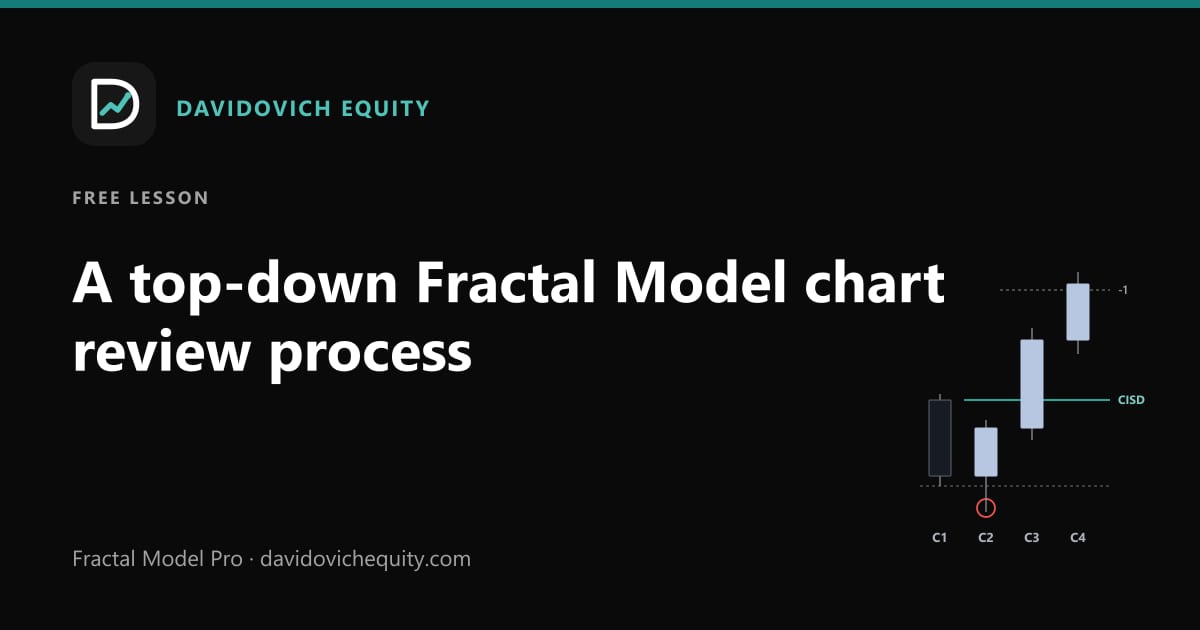
A useful chart review moves from broad context to specific confirmation. In the Fractal Model, that means forming a provisional bias, identifying a qualified location, tracking breach-and-reclaim geometry, and watching for the chart-timeframe trigger close that can expose a NOW setup before the model candle finalizes.
The sequence matters. Starting with a lower-timeframe signal and searching backward for a narrative makes it too easy to justify ordinary market noise.
This workflow is for education and chart study. It does not determine position size, personal suitability, or whether any trade should be taken.
The review sequence
Use the same order for both bullish and bearish scenarios:
Bias → location → developing breach and reclaim → trigger close → finalization or invalidation → objectives and risk → journal
Each stage must answer a different question. Evidence from one stage should not be used as a substitute for another.
1. Establish a provisional bias
Begin with the model-timeframe narrative. For the intraday chain used throughout this library, organize the charts as:
15m → 4H → 1D → 1W
The 15-minute chart provides the trigger close for the 4-hour model. Open the 4-hour chart for the full daily-model map, and open the daily chart for the full weekly-model map. FMP+ keeps one chart and model pair in charge on the active chart. Its parent read may preserve one parent state during drill-down using the same configured admission settings, but that state cannot alter the local pair's score, alerts, plan, or ownership.
Bias is a working hypothesis, not permission to trade. Record the nearby swing structure, the current Anchor-to-Finish phase, and meaningful open levels above and below price. If the timeframes conflict, write down the conflict instead of forcing them into agreement.
For a full explanation of these roles, read Multi-timeframe analysis: the 15m, 4H, 1D, and 1W trading chain. If the stage names are unfamiliar, start with The four-candle fractal model.
2. Identify the location
A reversal closure matters only when it forms at a meaningful model-timeframe location. Review location in this order:
- A confirmed swing high or swing low
- An active directional gap
- When neither is present, the immediately breached opposing reference candle permitted by the methodology
- When none of those qualifies, FMP+'s trailing 20-model-candle range extreme for a trend-colored blow-off top or bottom
Mark the exact feature before studying the lower timeframe. The fourth test is an FMP+ operational fallback, not a published source rule. A candle that reverses in the middle of an unqualified range should not be promoted to a valid Reclaim simply because its wick and close resemble one.
The location provides where a shift could matter. It does not prove that a shift has occurred.
3. Track the breach and developing reclaim
Next, identify the model-timeframe Anchor candle and observe whether price breaches its high or low.
For a developing bullish Reclaim candidate:
- Price trades below the previous candle's low.
- Price moves back above that breached low while the model candle is still forming.
For a developing bearish Reclaim candidate:
- Price trades above the previous candle's high.
- Price moves back below that breached high while the model candle is still forming.
At this stage the geometry is provisional. The apparent reclaim can disappear before the model candle completes. Candle color is not the rule; the original breach, qualified location, and movement back through the breached boundary define the candidate being monitored.
Review Breaches explained for the difference between a breach and acceptance beyond a level. Then use The Reclaim explained for the complete reversal test.
4. Require the trigger close
While the model candle is developing, its chart timeframe can record the trigger close.
For the 4-hour model, that confirmation is observed on the 15-minute chart. A bullish trigger requires a chart-timeframe body close above the defined bullish trigger line. A bearish trigger requires a body close below the defined bearish trigger line. A wick through the line is not the confirming event.
Pairing prevents an unrelated close elsewhere on the chart from being attached to the setup. The confirmation must belong to the model window and agree with its direction. When Require trigger close is enabled, the completed chart-timeframe body close exposes the setup as NOW immediately. That is an FMP+ heads-up extension for completed chart-timeframe evidence; the designation remains provisional until the model candle finalizes at its own boundary.
Read The trigger close explained for trigger-line construction, body-close confirmation, and pairing rules.
5. Let the model candle finalize or invalidate
The model-timeframe boundary decides whether the developing geometry survives as a finalized structural record.
- If the candle still closes back through the originally breached boundary, the NOW setup can finalize.
- If the reclaim fails before the boundary, the provisional attempt invalidates instead of being rewritten as a successful historical setup.
- If the trigger close arrives in the permitted next window after the original breach candle already reclaimed, FMP+ keeps the original geometry and designates the result as a delayed Reclaim rather than inventing a new setup.
This distinction is why a NOW label and a finalized model record can coexist without meaning the same thing.
6. Define invalidation and possible objectives
Before considering execution, write down what would disprove the scenario. Invalidation should be connected to the structure that created the idea, not moved later to protect a preferred opinion.
Also mark possible objectives as areas price may seek rather than promised targets. Depending on the chart, those references can include:
- Opposing open levels above or below the range
- A prior swing high or swing low
- The next qualified model-timeframe location
- Model projection levels used as measurement references
- For an Extend that followed through, the Extend midpoint or the wick zone relevant to Finish study
The distance between a contemplated entry, structural invalidation, and objective still has to fit the trader's independent risk rules. If the structure does not offer a coherent plan, the correct journal outcome can be “no trade.”
For the continuation sequence and the limits of wick-zone analysis, read Extend and Finish.
7. Journal the observation
Save the chart state and record the decision before revealing the outcome. At minimum, capture:
| Field | What to record |
|---|---|
| Timeframe chain | Separately opened chart and model charts and the job assigned to each |
| Bias | Bullish, bearish, neutral, or conflicted, with the structural reason |
| Location | Swing, active directional gap, opposing reference, or the FMP+ trailing-range fallback |
| Breach and reclaim | Breached level, original model window, and developing geometry |
| Trigger close | Trigger-line price, completed confirmation-bar time, and direction |
| Model status | NOW, finalized, invalidated, or delayed confirmation |
| Invalidation | The structural event that disproves the scenario |
| Objectives | Open levels or model references identified in advance |
| Outcome | Confirmed, failed, incomplete, or skipped |
| Process review | Which rules were followed, missed, or interpreted ambiguously |
Judge the process separately from the outcome. A losing observation can follow the written rules, while a profitable outcome can still expose poor discipline. Keep rule changes out of a single-trade reaction; collect enough examples to understand whether the issue is the method, its application, or ordinary uncertainty.
A compact pre-trade checklist
- Is the timeframe chain defined and internally consistent?
- Is the directional bias supported by model-timeframe structure?
- Did the breach occur at a qualified location?
- Did the developing model candle breach and move back through the correct boundary?
- Did the chart timeframe confirm with a completed body-close trigger?
- Is the setup still NOW, or has the model boundary finalized or invalidated it?
- Are invalidation and possible objectives written down in advance?
- Does the idea fit an independently defined risk plan?
- If any required answer is no, should the scenario remain pending or be skipped?
The process is intentionally selective. Its purpose is not to create a setup on every chart; it is to make the evidence, uncertainty, and reasons for action or inaction visible enough to review.
The product behind the lesson
See this on your own chart with Fractal Model Pro+.
Fractal Model Pro+ is the TradingView indicator that marks the breach, the Reclaim closure, the trigger close, and the Anchor-to-Finish map for the chart and model timeframes on your chart, in the same reading order this lesson follows. Access is invite-only on your TradingView username. It is educational software: it places no trades and makes no outcome claims.
Free primer by email
Get the 13-page primer and the next lesson.
The beginner primer arrives right away, then one email when a new research lesson goes out, plus Fractal Model Pro+ product updates. Written material only.
Lessons and product updates only. No trade signals, no performance or results claims. Unsubscribe from any email. How we handle your data.