See the level that matters
FMP keeps the active higher-timeframe location and the price reference being tested in one chart view.
Flagship · invite-only TradingView access
Turn a complex chart into four visible questions: which level matters, was it swept, did the smaller timeframe confirm a shift, and where does the idea fail?
FMP answers those questions with its C1–C4 model, paired-timeframe CISD, invalidation, objectives, and current-pair model state.
$49/month or $499/year — annual saves $89(15%) versus twelve monthly payments Fulfilled within 24 hours after username confirmation and successful checkout
Zone precision
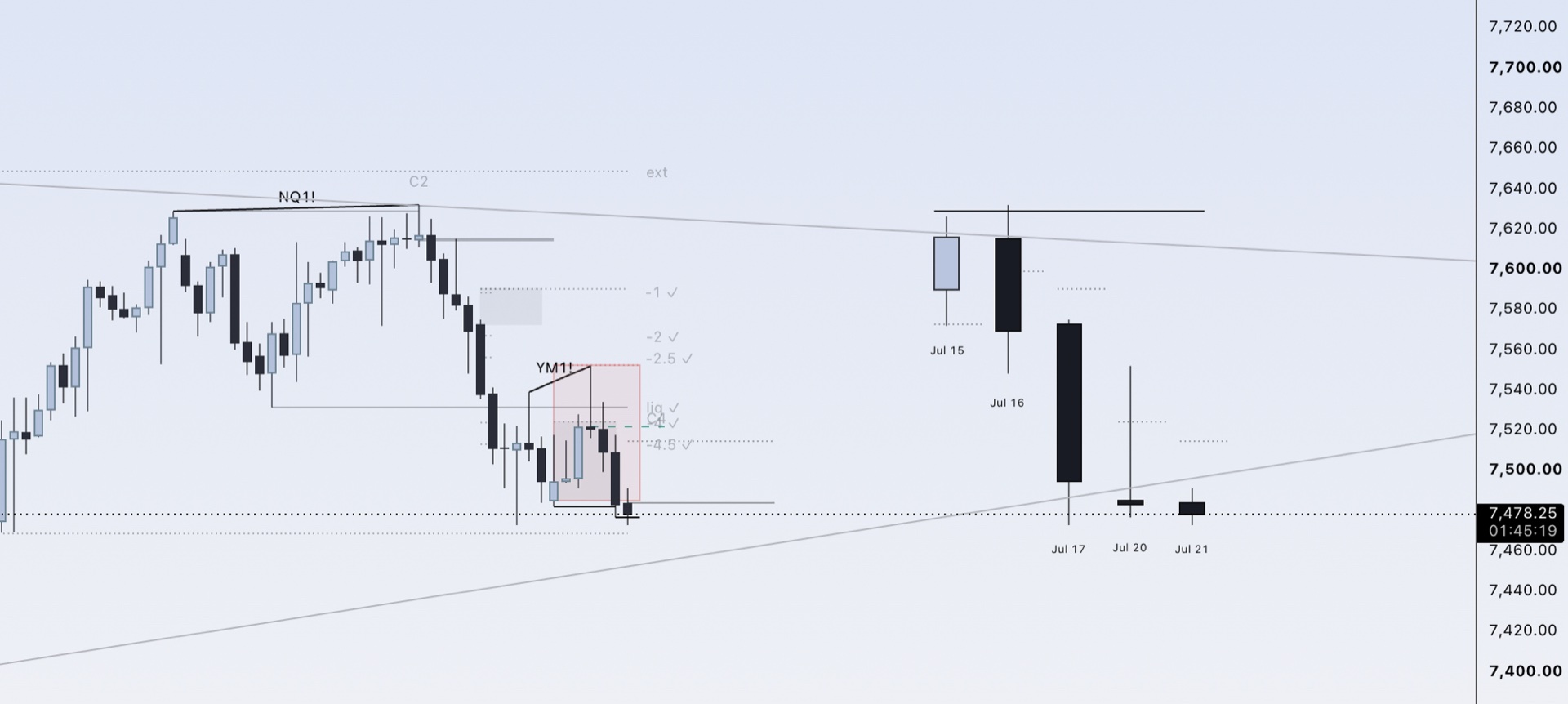
The shaded continuation zone appears only after a delivered Candle 3, and it is computed from that candle's completed range together with the new period's open — a level that already existed the moment the period opened, not one fitted after the retrace. In this ES capture the retrace wicked into the zone's edge, an SMT divergence tag printed at the same touch, and the objective ladder shows which levels FMP had marked delivered at that point.
A zone touch is never treated as an entry by itself: the model still requires a fresh paired-timeframe confirmation after the retrace, and a retrace deeper than the zone invalidates the continuation premise instead of repainting it.
What FMP keeps visible
FMP runs one confirmation/model pair at a time. Broader charts stay on their own charts, so the active pair never inherits state it did not measure.
FMP keeps the active higher-timeframe location and the price reference being tested in one chart view.
A wick is not treated as a setup. The paired smaller timeframe must confirm the change in delivery.
The sweep extreme defines invalidation while measured objectives organize review. Failed maps are removed by default; optional ghosting keeps a short audit trace.
The smaller timeframe supplies body-close CISD confirmation; the model timeframe owns C1–C4 structure. The pairings below are FMP's exact Automatic product map, including its deliberate fast-chart and higher-chart adaptations. C2/C3 stage toggles change display only; detection, ownership, scoring, monitor state, and alert eligibility continue.
| Confirmation | Model |
|---|---|
| 1s | 1m |
| 15s | 5m |
| 1m | 15m |
| 3m | 30m |
| 5m | 1H |
| 15m | 4H |
| 1H | 1D |
| 4H | 1D |
| 1D | 1W |
| 1W | 1M |
Automatic mode resolves only supported chart timeframes. An unsupported interval pauses the model and names the issue rather than silently selecting a different pair.
As an FMP heads-up extension, a completed paired-timeframe close can expose a developing setup before the model candle closes. The model-timeframe boundary later finalizes the structural record. If provisional geometry fails, it is invalidated rather than rewritten as a successful historical setup.
One confirmed reversal owns the active liquidity and projection map. Same-direction delivery advances through C3 and C4 without repeatedly replacing the original setup with a newer rolling Candle 2.
The sweep extreme frames invalidation context. Liquidity, equilibrium, and standard-deviation objectives organize the path forward, but they are reference levels—not forecasts or guaranteed destinations.
C4 context is actionable only after a delivered C3. The model ends at C4; it does not invent C5 or C6 zones, and an invalid directional-half premise does not remain active simply because a label once appeared.
Model cycle
01
C1 marks the prior high or low that gives the developing idea a clear reference.
02
C2 moves through that reference and closes back, creating a reversal candidate—not a signal.
03
A completed close on the paired smaller timeframe confirms that price delivery shifted.
04
C3 and C4 show whether the confirmed move continues, slows, or reaches its terminal stage.
Four-candle model
C1 frames the range; a valid C2 can lead into C3 delivery and the terminal C4 stage.
The labels describe function, not candle count alone. C3 follows a valid C2, and actionable C4 context requires a delivered C3.
Optional trade planner
Auto frames the confirmed reversal block after a POI-qualified C2 and paired-timeframe CISD. A qualified C3 selects the later FVG-first Continuation workflow and waits for a fresh confirming closure. The planner stores and displays one plan, never parallel alternatives.
Off by default
Planner logic
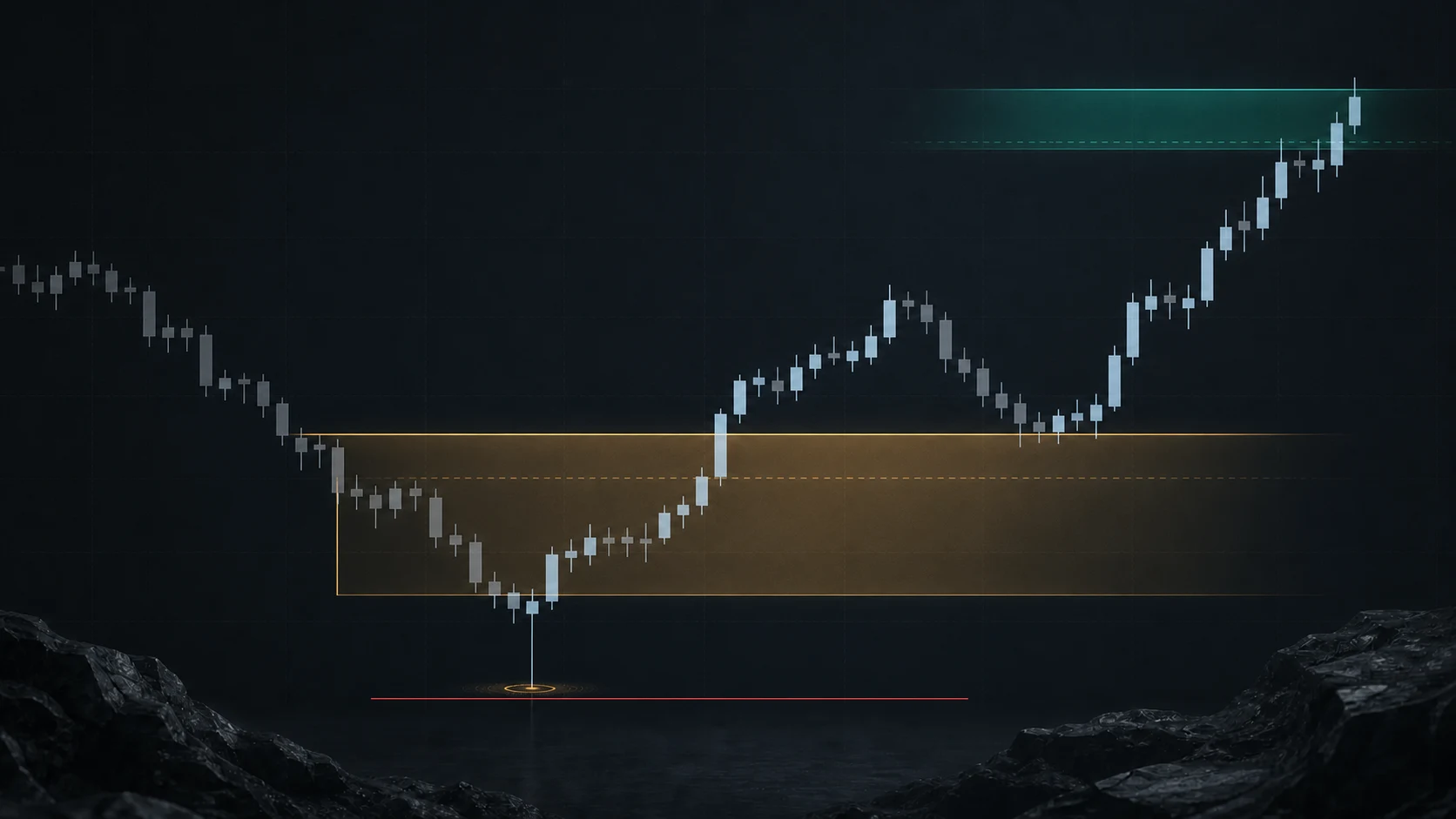
C2 sweep → paired CISD → confirmed block → later retest
Amber marks the confirmed reversal block. Red marks structural invalidation. Teal marks the nearest active draw—not a forecast or guarantee.
C2 sweep
A POI-qualified C2 purges liquidity and establishes the structural extreme.
Paired CISD
A completed paired close confirms the reversal.
Frame the C2 OB
FMP frames the confirmed reversal block: proximal edge as the retest line, distal edge as the structural stop.
Wait for retest
A later completed bar may revisit the block; T1 uses the nearest active draw.
Default setup: C2 order block · Continuation mode adds POI search + fresh closure · never an automatic signal
Chart workflow
Location comes before pattern, confirmation comes before execution, and invalidation comes before any objective.
01
Define the higher-timeframe idea before treating any sweep or closure as meaningful.
02
FMP requires the sweep to have formed at qualified model-timeframe structure before any reversal is admitted. It evaluates several classes of location — confirmed swings, active directional fair value gaps, and other point-of-interest candidates — under a fixed internal precedence, and reports which one qualified, so validity is auditable rather than assumed.
03
C2 trades through the prior reference and moves back through it. A paired close can confirm LIVE geometry before the model candle finalizes.
04
The paired lower timeframe must body-close through the CISD level before FMP treats the swing as confirmed.
05
Use the sweep extreme for invalidation context and follow C3/C4 delivery, equilibrium, and objectives as the model develops.
Learn the model
The research library explains the same rules shown by the indicator, including the conditions that reject a setup and the difference between live and finalized state.
Learn the complete four-candle sequence before studying individual setups.
Read the lesson →See why sweep, reclaim, and higher-timeframe location must work together.
Read the lesson →Understand the lower-timeframe body close that confirms a developing swing.
Read the lesson →Review one confirmation/model pair at a time and record broader charts separately.
Read the lesson →FMP questions
Fractal Model Pro (FMP) is an invite-only TradingView indicator that shows the level price is testing, whether it was swept, whether a smaller timeframe confirmed the shift, where the idea fails, and how the move develops. Its technical model uses C1–C4 structure and paired-timeframe CISD.
No. FMP is a decision-support and market-structure tool. Its optional Auto trade planner selects one workflow from the latest qualified C2 or C3 stage, but it never issues an automatic buy or sell command. The trader remains responsible for bias, risk, execution, and whether a setup fits the broader context.
The feature is off by default. When enabled, Auto uses the confirmed reversal block after a POI-qualified C2 with paired-timeframe CISD. A qualified C3 selects one FVG-first Continuation plan and waits for a fresh confirming closure. Auto replaces only an unresolved C2 plan, never displays simultaneous alternatives, and clears on stop, target, a newer setup, or disable.
The model timeframe supplies the C1–C4 structure while the paired lower timeframe supplies CISD confirmation. FMP runs only the active chart’s pair; it does not carry broader-chart state, zones, votes, or bias into that pair.
Yes. FMP distinguishes developing paired-timeframe confirmation from finalized higher-timeframe structure. A live setup can invalidate if its required geometry fails before finalization.
The framework is market-agnostic, but every instrument has different liquidity, session behavior, and risk. Examples on this site often use CME index futures for education and do not imply that the same execution is appropriate for every trader.
Separate-chart review
The model-timeframe location remains a required qualification by default. FMP does not carry broader-chart state into the active pair; open those charts separately and record their reads before returning to the execution chart.
01 · Confirmation
15m
02 · Model
4H
Fractal Model Pro access
Fractal Model Pro is distributed as an invite-only script through the FMP Trader plan: $49/month, or $499/year, which saves $89(15%) against $588 in twelve monthly payments. Create your account and add the TradingView username that should receive access.Once your username is confirmed and checkout succeeds, access is granted within 24 hours.
FMP is an educational decision-support tool. It does not place trades, provide individualized advice, or guarantee outcomes.