Sweeps and pivots: what a run through a level means
Lesson 2 for new traders: how a sweep differs from a breakout, why location matters, what a gap is, and what the pivot dot marks.
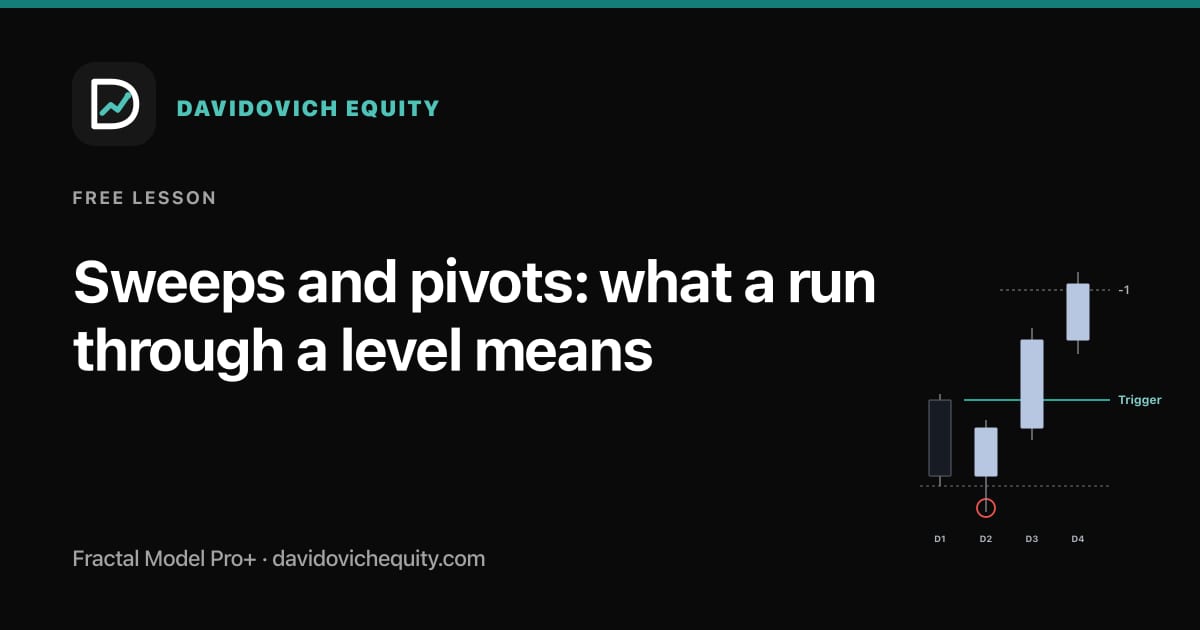
This is the second lesson in the series. It follows Highs and lows: why price reaches for them and assumes no trading experience.
Also called a stop run, a raid, or a liquidity sweep in other trading material. The pivot is also called a protected swing.
What a sweep is
A candle has a body, the part between its open and its close, and wicks, the thin lines above and below. A wick shows how far price traveled. The body shows where it settled.
A sweep is price trading past a visible high or low, then closing back inside the old range. The wick reaches past the level, the orders waiting there fill, and the body ends on the original side of the level.
For example, yesterday's low was 100. Today price drops to 98 and the candle closes at 101. Price swept the low.
Sweep or breakout: the close decides
Both start the same way, with price trading through an old high or low. The body close separates them:
- Breakout. The body closes beyond the level. Price stayed out there.
- Sweep. The body closes back inside. Price went out and came back.
You cannot tell which one you have while the candle is still forming. A candle that looks like a sweep halfway through can still close beyond the level. Wait for the close.
Candle color does not matter. A green candle can sweep a high.
Sweep or breakout
The close decides: back inside, or beyond.
Two candles reach below the same prior low. One closes back above it, a sweep. The other closes below it, a breakout.
While the candle is still forming you cannot tell which one it will be. Wait for the body to close.
- Sweep: closes back inside
- Breakout: closes beyond
- Prior low
Bullish and bearish sweeps
FMP+ starts from a range candle (D1 Range). Its high and low are the range high and range low, and a sweep takes one of them.
- Bullish sweep. Price trades below the range low and closes back above it. Sellers pushed through a known low and could not keep price there.
- Bearish sweep. Price trades above the range high and closes back below it.
Neither means price must reverse. A sweep is an event. It still needs a good location and a confirmation.
When one candle goes both ways
Sometimes one candle runs past both the range high and the range low. FMP+ reads it in one direction only, the direction it closes. If it closes above the range high, it can count as a bullish sweep of the low. If it closes below the range low, it can count as a bearish sweep of the high. If it closes back inside the range, neither side counts.
What a gap is
A gap is a pattern of three candles. When the wicks of the first and third candles do not overlap, the price range between them is a gap. In a rise, the third candle's low sits above the first candle's high. Only the fast middle candle moved through that range.
FMP+ uses gaps in two places: as a qualified location for a sweep, and as a test for the pivot below.
Why location matters
Charts print small sweeps all day. Most are noise, such as a wick past a minor wiggle inside a quiet range. A sweep matters at a level that matters on the higher timeframe.
FMP+ checks for a qualified location in this order:
- A swing high or low that is confirmed and has not been swept before.
- An active gap in the direction of the sweep.
- The high or low of the range candle the sweep passed, when neither of the first two exists.
- The highest high or lowest low of the last 20 higher-timeframe candles, for runs to new records with no structure beyond them. This is FMP+'s own fallback, not a published rule.
FMP+ ignores a sweep without a qualified location, however clean its shape.
What a pivot is
After a sweep, price moves away from the swept level, usually with pullbacks. The pivot is the latest pullback extreme that earned protection. The steps below describe a bullish setup; a bearish one mirrors them.
- Price pulls back in a run, a streak of down candles.
- The lowest point of that pullback qualifies only if it traded into a gap or took out a short-term swing low, either one formed since the last pivot. A short-term swing low is a candle whose low sits below the candles on either side of it.
- A candle then closes back above the open of the down run that made the pullback low.
That low is the pivot, the latest protected low. It is called protected because price dipped there and then closed back through the pullback that made the dip.
Protected pivot
A pullback low is protected once price closes back through its run.
After a sweep, price pulls back into a gap, then a candle closes above the open of the down run that made the pullback low.
That low is now the pivot, the latest protected low. FMP+ marks it with one small dot and moves the dot as each new one forms.
- Close back through the run
- Gap the pullback reached
- Pivot: the protected low
Once FMP+ draws a confirmed setup, it marks the pivot with one small round dot, under a low or over a high. The dot moves as each new pivot forms. A pullback that fails the test gets no dot, and neither does the sweep extreme, which its tag already marks. The dot clears when the setup completes.
The dot is a reference mark, not a trade signal.
How FMP+ uses this
FMP+ looks for a sweep at a qualified location on a higher-timeframe candle. It names the swept level on the chart, for example 4H low · 7592.00 swept, and tags a confirmed sweep as a D2 Sweep, the second step of its four-candle model: D1 Range, D2 Sweep, D3 Expansion, D4 Continuation.
A sweep alone is only a candidate. The next lesson covers the trigger close that confirms it.
Checklist
- Which exact high or low was swept?
- Did the body close back inside, or is the candle still forming?
- Is the sweep at a swing, a gap, the range candle's extreme, or a run to a new record?
- Did the pullback low reach a gap or take out a short-term swing, and did a candle then close back through the run that made it?
FAQ
Is a sweep the same as a stop hunt?
No. "Stop hunt" assumes a motive a chart cannot show. "Sweep" describes only what you can see: price through a known high or low, then the close.
Does a sweep mean price will reverse?
No. A sweep at a good location is a candidate, and even a confirmed setup can fail.
Does the pivot dot mean price will hold there?
No. The dot marks the latest protected swing. It is a reference, not a prediction.
Next lesson: The trigger close
This lesson is education, not financial advice. Trading futures involves substantial risk of loss.
The product behind the lesson
See this on your own chart with Fractal Model Pro+.
Fractal Model Pro+ is the TradingView indicator that marks the sweep, the close back inside, the trigger close, and the D1 to D4 map for your chart and model timeframes, in the same reading order this lesson follows. Access is invite-only and tied to your TradingView username. It is educational software: it places no trades and makes no outcome claims.
Free primer by email
Get the 13-page primer and the next lesson.
The beginner primer arrives right away. After that you get one email per new research lesson, plus Fractal Model Pro+ product updates. Written material only.
Lessons and product updates only. No trade signals, no performance or results claims. Unsubscribe from any email. How we handle your data.